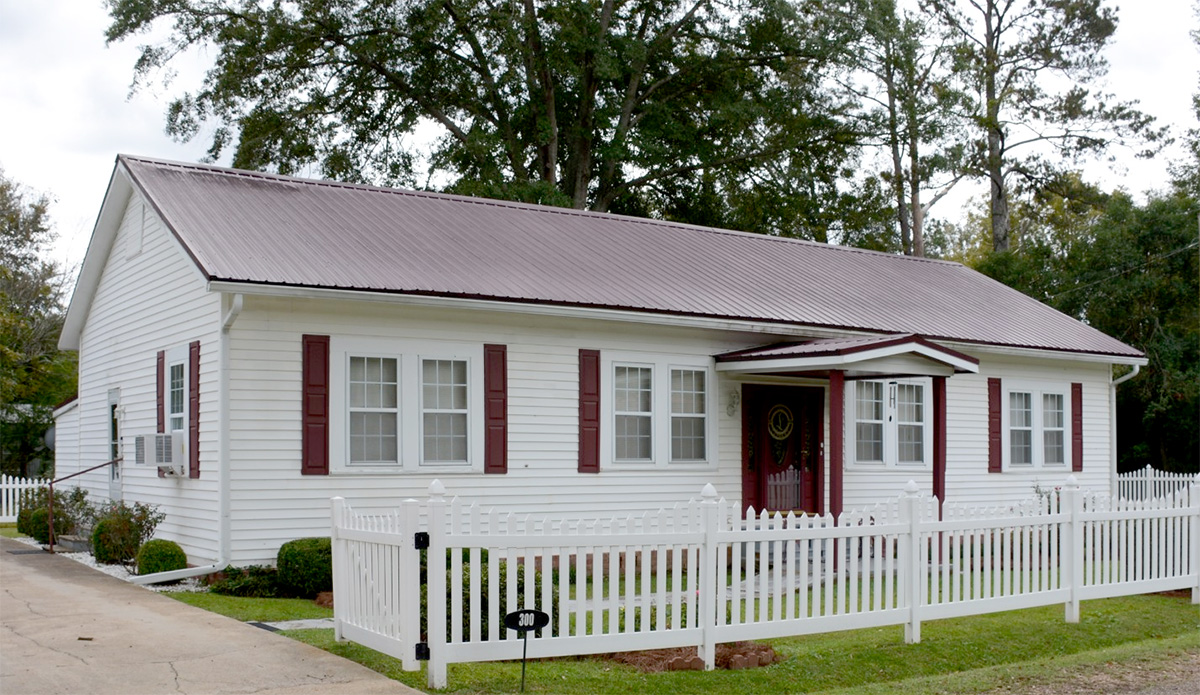
The "Colored Public School of Terry" was built as a Rosenwald School, one of over 5,500 such buildings built throughout the South with both private and public funding for Black students.
Objects from schools that once served Black students
will be considered for 2027 exhibit.
In preparation for an August 2027 temporary exhibit, curators with the Mississippi Department of Archives and History are calling on the public to share their artifacts from Rosenwald Schools that opened a century ago to serve Black students.
Rosenwald Schools are named for Julius Rosenwald, a millionaire philanthropist who was president and part owner of Sears, Roebuck and Company. He was inspired by and partnered with Booker T. Washington to fund schools for Black children across the South, beginning with six in Alabama that opened in or between 1913-1914. There were 4,978 total Rosenwald schools. In Mississippi, there were more than 500 schools, second in number to North Carolina.
MDAH is calling on residents to search through their attics, closets and trunks for precious objects associated with the Rosenwald schools in Mississippi. The artifacts could take any form – a teacher’s log, teaching license, photos, desks, chalkboards, textbooks or even cafeteria trays.
“Behind every artifact is a human story. Through these everyday school objects, we hope to bring to life the experiences of the students, teachers and communities whose lives were transformed by Rosenwald Schools,” said Ivette Ray, director of curatorial services within the MDAH Museum Division.
These items will be considered for an MDAH exhibit that will open in August alongside the traveling photography exhibit, “A Better Life for Their Children: Photographs and Stories by Andrew Feiler.”
People are asked to send a description and photo of their objects to info@mdah.ms.gov.
Background on Schools in Mississippi According to a “Mississippi History Now” article by former MDAH architectural historian Jennifer Baughn, public schooling in Mississippi did not become commonplace until after the Civil War.
When the United States Supreme Court decided in its 1896 Plessy v. Ferguson ruling that states could require separate public facilities for Black and White people as long as they were equal (the so-called “separate but equal” doctrine), White-dominated school boards began concentrating on funding schools for White children, rather than for Black. By the early 1900s, while many White children studied their textbooks in new functional buildings, Black students were often left to make do in churches, lodges, and poorly constructed buildings.
Prentiss Institute in Jefferson Davis County
Beginning in the 1910s, however, new school buildings for Black students began to spring up on the Mississippi landscape as Rosenwald partnered with mostly Black communities. The last school was built in 1937.
In 2002, the National Trust for Historic Preservation placed Rosenwald Schools on its 11 Most Endangered Historic Places list, and in 2011 the Trust included the schools in its portfolio of National Treasures – nationally significant but threatened historic treasures.
In February 2026, the Terry Rosenwald School in Hinds County, which was established as the "Colored Public School of Terry," was listed in the National Register of Historic Places. The school building on this site is documented as “Terry School” on a school card in the records of the Julius Rosenwald Fund Collection at Fisk University.
Mississippi is believed to be among only a few states to have completed as comprehensive a survey of Rosenwald schools or historic schools in general.
Only a few Rosenwald buildings are known to survive in Mississippi: Bay Springs School, Forrest County (1925); Brushy Creek School, Copiah County (ca. 1930); Bynum School, Panola County (1926); Coahoma Agricultural High School (ca. 1930; now Coahoma Community College); Drew School, Sunflower County (1929); Hollandale School, Washington County (1924; only a section survives, and it has been extensively altered); Marks School, Quitman County (1922); Moorhead Schoolteacher’s House, Sunflower County (1932); Nichols Elementary School, Canton, Madison County (1927); Oak Park Principal’s Home and Girls’ Dormitory, Laurel, Jones County (1928); Pantherburn School, Sharkey County (1927; altered, now serves as a church); Pass Christian (Randolph) School, Pass Christian, Harrison County (1928); Prentiss Institute, Prentiss, Jefferson Davis County (1926); Rose Hill School, Sharkey County (1922; badly deteriorated); Sherman Line School, Amite County (1928); Swiftown School, Leflore County (1921; may not be a Rosenwald School); Walthall County Training (Ginntown) School, Walthall County (1920); John White Schoolteacher’s House, Forrest County (1925).
State of Mississippi, federal and local leaders, and private supporters unite to advance the transformative museum project. From left, Vicksburg National Military Park Superintendent Treacy Stone, Deputy Assistant Secretary for Fish, Wildlife, and Parks Aaron Calkins, U.S. Senator Cindy Hyde-Smith, Brig. Gen. (Retired) Robert Crear, MDAH Board of Trustees President Spence Flatgard, U.S. Senator Roger Wicker, U.S. Representative Bennie Thompson and Lt. Governor Delbert Hosemann.
State, federal and local leaders joined the Friends of Vicksburg National Military Park and Campaign today to announce a historic partnership advancing plans for a new Vicksburg Civil War Visitor Center and Museum. The project will create a modern gateway to the Vicksburg Campaign, strengthen the visitor experience and help ensure that the full story of this pivotal chapter in American history is preserved and shared with future generations.
The announcement represents a significant milestone in the effort to replace the park’s aging, flood-prone visitor center with a modern facility designed to serve visitors, students, researchers and the broader community.
The project, estimated at $114 million, reflects an extraordinary commitment of public and private support, including $56 million from the State of Mississippi, $15 million in private commitments, $3 million in federal funding secured to date and up to $15.5 million in local support approved by the City of Vicksburg and Warren County boards. Additional private fundraising and anticipated appropriations remain critical to advancing this transformative project.
“This project represents an extraordinary investment in Mississippi’s history and in the future of our state,” said Spence Flatgard, president of the Board of Trustees of the Mississippi Department of Archives and History. “Through this partnership, we have an opportunity to create a world-class visitor experience that honors the significance of the Vicksburg Campaign, expands educational opportunities and ensures that this pivotal chapter in American history is preserved and shared with generations to come.”
The announcement featured remarks from Mississippi Lt. Gov. Delbert Hosemann; U.S. Sens. Roger Wicker and Cindy Hyde-Smith; U.S. Rep. Bennie Thompson; and Aaron Calkins, representing the U.S. Department of the Interior. Spence Flatgard represented the Mississippi Department of Archives and History, and retired General Robert Crear, president of the Friends of Vicksburg National Military Park and Campaign, spoke on behalf of the nonprofit organization leading private fundraising for the project.
Local support
The approval of local funding by the Vicksburg City and Warren County boards on Monday marks another significant step forward for the project. Recognizing the substantial economic benefits the new Vicksburg Civil War Visitor Center will bring, including increased tourism, job creation, sales tax revenue and broader economic growth, local leaders have committed to an alliance that builds on federal, state, and private investments. Through the use of a portion of tax revenues generated by Entergy’s new advanced power station, up to $15.5 million over 30 years will support the project, demonstrating a bold investment in Vicksburg’s and Warren County’s future.
A new gateway to the Vicksburg Campaign
The State of Mississippi will own the new facility, with the National Park Service serving as its long-term tenant and interpretive partner. The Friends of Vicksburg National Military Park and Campaign is leading private fundraising efforts and supporting project marketing and public engagement.
The planned facility will feature immersive museum exhibits, expanded interpretation of the campaign and its impact on soldiers and civilians, educational and classroom space, research and archival resources, and flexible areas for public events and living history programs.
It will also help orient visitors to the broader Vicksburg Campaign landscape, including sites beyond the core battlefield, and better serve school groups, independent travelers and visitors arriving by riverboat.
Private philanthropy strengthens the partnership
Private support is an essential component of the project, reflecting a shared commitment among individuals, corporations and foundations to preserving American history and creating a lasting educational and cultural resource for Mississippi.
Leading private supporters recognized at the announcement include:
John L. Nau III
Blue Cross & Blue Shield of Mississippi
Amazon
The Ergon Foundation
Trustmark
Betsy and Kane Ditto
Entergy Mississippi
The Golding Foundation
Penny and Mack Varner
Corin and Bob Morrison
Waring Oil and Neill Gas
“Projects of this magnitude require more than public investment. They require people who believe that preserving our nation’s history is a responsibility worth sharing,” Crear said. “We are deeply grateful to the individuals, corporations and foundations who have stepped forward to help bring this vision to life. Their leadership has helped establish a strong foundation, but our campaign is not finished. We must continue raising the private support needed to complete this effort, while working with our federal, state and local partners to secure the appropriations necessary to complete the project. We invite others who believe in the importance of Vicksburg and our national parks to join us in this campaign.”
An opening salvo for the campaign
The announcement culminated in a symbolic signing ceremony featuring a replica Parrott shell, recalling the artillery used during the Vicksburg Campaign. Public officials and leading private supporters were invited to sign the replica, marking the opening salvo of the campaign to bring the new visitor center and museum to fruition.
“The Vicksburg Campaign began with an opening salvo,” Crear said. “Today, we begin another campaign, one to build a place worthy of telling the story of the men and women whose lives were forever changed here. Our opening salvo is a commitment to partnership, preservation and the generations who will come to Vicksburg to understand this pivotal moment in our nation’s history.”
The shell signing symbolized the collective effort ahead: a campaign built not with artillery, but with partnership, philanthropy and a shared commitment to preserving the nation’s history.
A lasting investment in history and the future
Since 2008, the Friends of Vicksburg National Military Park and Campaign has contributed millions of dollars in private support to battlefield restoration, monument preservation, educational programs, living history, special events and student field trips. The organization works in partnership with the National Park Service to preserve the battlefield and expand public understanding of the Vicksburg Campaign.
The new visitor center builds on that commitment while creating a modern facility capable of meeting the needs of today’s visitors and future generations. The project also presents an opportunity to strengthen tourism, support the regional economy and ensure that Vicksburg’s nationally significant history remains accessible and meaningful.
The Friends of Vicksburg National Military Park and Campaign will continue working with public partners and private supporters to advance the project and secure the remaining resources needed to realize its vision.
For additional information about the project, plans and architectural renderings, visit www.friendsofvicksburg.org.
About the Vicksburg Civil War Visitor Center
The Vicksburg Civil War Visitor Center is a landmark public-private partnership among the State of Mississippi, the National Park Service and the Friends of Vicksburg National Military Park and Campaign. Planned for a 12.7-acre site adjacent to Vicksburg National Military Park and highly visible from Interstate 20, the 60,000-square-foot facility will include a 16,000-square-foot immersive museum exploring Vicksburg’s role in the Civil War, from the prewar era through the campaign, siege, occupation, Reconstruction and the establishment of the national military park. Additional features will include archival storage and research space, a multipurpose event space, a retail store and café, and outdoor areas for educational programming and living history demonstrations. The project is designed to serve as a gateway to the Vicksburg Campaign landscape while expanding opportunities for education, cultural tourism and economic development. An economic study projects $231 million in total economic impact during the first seven years, $28.3 million in new federal, state and local tax revenue, 200,000 additional annual visitors to the Vicksburg region and 1,630 jobs created. The center is anticipated to open in 2030.
About the Friends of Vicksburg National Military Park and Campaign
The Friends of Vicksburg National Military Park and Campaign is the official nonprofit partner of Vicksburg National Military Park. Since 2008, the organization has raised and contributed private funds to support battlefield restoration, preservation, educational programming, living history, special events and other initiatives that enhance the park and share the history of the Vicksburg Campaign. Learn more at www.friendsofvicksburg.org.
About MDAH
Founded in 1902, the Mississippi Department of Archives and History collects, preserves, and provides access to the archival resources of the state. The agency empowers people and places by telling Mississippi’s many stories.
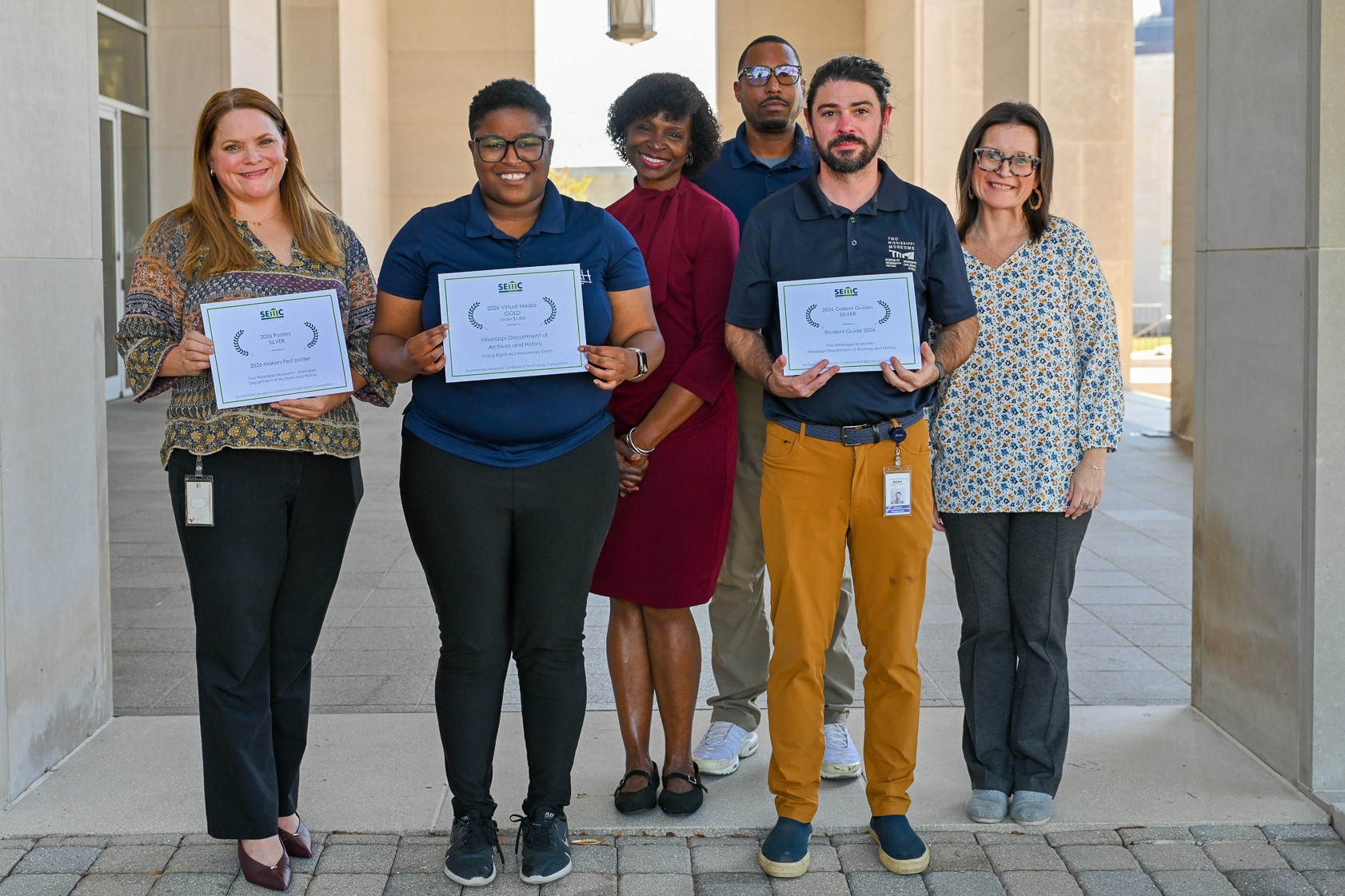
MDAH WINNERS: MDAH Southeastern Museums Conference Awards winners, from left to right, Tori Rice, Mikailah Jefferson, Shelia Byrd, Rodney Thompson, Mike Bienkowski and Elizabeth Grey.
The Mississippi Department of Archives and History is the recipient of three 2026 Southeastern Museums Conference Awards, including a Gold Award for a digital series about the Voting Rights Act of 1965.
During the SEMC awards luncheon recently held in Winston-Salem, North Carolina, MDAH was recognized with the following awards:
Gold Award in Virtual Media: Project Under $1,000 for the Voting Rights Act of 1965 Anniversary Shorts campaign.
Silver Award in Gallery Guide: Student Guide 2026
Silver Award in Posters: 2026 Makers Fest Poster
Recipients of the awards were judged by an appointed jury of museum professionals across the region who specialize in the fields of digital media, graphic design, publications and technology.
“The series of shorts on the Voting Rights Act of 1965 put together by our Digital Marketing team was extraordinary,” said Barry White, director of MDAH. “It’s a great honor to be recognized by SEMC.”
The MDAH Voting Rights Act Anniversary Shorts campaign was an entry in the SEMC Technology Competition that recognizes effective design, accessibility, creativity, and pride in work and recognition of institutional identity. The campaign was a series of short videos visualizing 10 topics within the scope of the Voting Rights Act of 1965 and features historical sound recordings, documents, and archival images from the MDAH collections.
The series highlights the severe barriers Black Americans faced before 1965—including poll taxes, literacy tests, violent intimidation, and economic retaliation—and the landmark legislation that outlawed these discriminatory practices.
The SEMC Publication Design Competition recognizes and rewards excellence in graphic design in Southeastern museum publications. The competition encourages communication, effective design, creativity and pride in work, and recognition of institutional image and identity.
The 2026 Makers Fest poster promoted the annual concert that features Mississippi artists and is free to the public. The Gallery Guide: Student Guide 2026 is used by teachers and students who visit the Two Mississippi Museums.
Award winners will be listed in the Winter 2027 edition of “INSIDE SEMC,” a digital publication of the Southeastern Museums Conference.
About the Southeastern Museums Conference: The Southeastern Museums Conference (SEMC), a nonprofit membership organization, “is an association of museums, museum staff, independent professionals and corporate partners. We focus on the Southeastern United State including: Alabama, Arkansas, Florida, Georgia, Kentucky, Louisiana, Mississippi, North Carolina, South Carolina, Tennessee, Virginia, West Virginia, Puerto Rico, and US Virgin Islands.”
GRAND OPENING: Restauranteur John Tierre cuts the ceremonial ribbon marking the opening of the Nissan Café by John Tierre Hospitality at the Two Mississippi Museums in Jackson.
Nissan Café by John Tierre Hospitality, a new eatery specializing in Southern-inspired cuisine, is now open at the Two Mississippi Museums — the Museum of Mississippi History and the Mississippi Civil Rights Museum.
The restaurant is a collaboration between John Tierre Hospitality, the Mississippi Department of Archives and History and the Mississippi Department of Rehabilitation Services' Business Enterprise Program. Representatives from those agencies, Visit Jackson, the City of Jackson and the Greater Jackson Chamber Partnership celebrated the opening during a ribbon-cutting ceremony on Oct. 16.
“We’re excited to welcome Tierre’s culinary vision to the Two Mississippi Museums through our collaboration with the Mississippi Department of Rehabilitation Services’ Business Enterprise Program,” said Barry White, director of MDAH, which administers the museums. “The café not only serves our museum visitors, but it also expands job opportunities and adds to the vibrant Downtown Jackson restaurant landscape.”
Tierre is a Jackson entrepreneur, promoter and restaurant owner who has built his career around business, hospitality and community involvement. Located at 222 North St., Nissan Café will offer visitors a taste of the flavors and hospitality found at Johnny T’s Bistro & Blues, Tierre’s restaurant on historic Farish Street.
Chef Bryan Myrick’s menu will feature daily plate lunch specials throughout the week, with selections that may include red beans and rice, chopped steak, barbecue ribs, baked chicken and blackened catfish.
Tierre arrived in Mississippi in 1995 on a tennis scholarship to play for Jackson State University, where he earned a bachelor’s degree in business administration. He said opening in the Nissan Café represents another opportunity to invest in and give back to the Jackson community.
“We want to provide jobs and top-tier cuisine in an underserved area,” Tierre said. “Jackson is starting to show signs of considerable business growth for locals and visitors, and we are grateful to be a part of that growth.”
In accordance with the Randolph-Sheppard Act, state entities are required to give priority to licensed blind vendors through BEP when providing food service opportunities in their buildings.
Through its partnership with MDRS, John Tierre Hospitality operates Nissan Café as part of a food service opportunity supported by the BEP.
Tierre is the private business operator partnering with MDRS’ BEP. A licensed blind vendor is currently not assigned to the location. However, until the BEP Committee assigns a licensed blind vendor to the location, proceeds from Nissan Café will benefit the BEP Committee. Once a licensed blind vendor is assigned, the location will provide an opportunity for that vendor to operate a business through the program.
BEP is administered by the MDRS Office of Vocational Rehabilitation for the Blind (VRB), which provides individuals who are legally blind with the training, resources, and support needed to become licensed vendors and successfully own and operate businesses.
“(This is) another successful entrepreneurship opportunity for legally blind Mississippians who want to be self-employed and partner with a small business in our great state,” said Dorothy Young, MDRS director, Office of Vocational Rehabilitation for the Blind.
Through opportunities like these, and the well-known Micro Markets, MDRS supports employment, entrepreneurship and economic independence while strengthening partnerships with communities and government entities across Mississippi.
“Over the last 90 years, this program has really expanded to all kinds of state-owned properties,” MDRS Executive Director Billy Taylor said. “We’re glad to have a BEP location in the Two Mississippi Museums cafe providing food services.”
Nissan Café hours are Tuesday-Friday, 11 a.m.-2 p.m.; Saturday and Sunday, 11 a.m.-3 p.m.
For more information, email info@mdah.ms.gov.
About MDAH Founded in 1902, the Mississippi Department of Archives and History collects, preserves, and provides access to the archival resources of the state. The agency empowers people and places by telling Mississippi’s many stories.
About MDRS The Mississippi Department of Rehabilitation Services (MDRS) is a state agency that provides resources to help Mississippians with disabilities find new careers, live more independently, overcome obstacles, and face new challenges. Learn more at www.mdrs.ms.gov.
For more information about the Business Enterprise Program and how it empowers visually impaired entrepreneurs, visit MDRS BEP or call 1-800-443-1000 to inquire more information on establishing one at your government entity.
For three years, Donita Morgan has given her time to the Two Mississippi Museums, welcoming visitors, sharing their stories, and helping guests connect with Mississippi’s history. In that time, she has volunteered more than 1,000 hours.
Now, she is giving something else: a $25,000 gift to the museums she believes in so deeply.
Morgan’s support came without a solicitation. She chose to make the gift because of what she has experienced firsthand as a volunteer and what she believes the museums mean for Mississippi and its future.
“Donita has given the museums something that cannot be measured in hours alone,” said Michael Morris, director of the Two Mississippi Museums. “She has shared her time, her energy, and her belief in what these museums do for Mississippi. For her to now make such a generous financial gift is incredibly meaningful. Donita’s generosity is a wonderful reminder that everyone has a role to play in helping the museums continue to serve our state.”
Though Morgan is originally from Chicago, she calls Mississippi home. Both sides of her family have roots in the state, and she believes the Two Mississippi Museums show what Mississippi can be at its best.
“Visitors from all over the world often tell me they’re some of the best history museums they’ve ever seen. What makes them so powerful is that they provide a full, unvarnished look at our history. That allows people to understand our past and our present, and gain insight into what we need to move forward together.”
Morgan’s decision to support the museums was driven not only by their educational resources and inclusive approach to Mississippi history, but also by the impact of their programs in communities across the state.
“By offering free group visits for schools and churches and hosting programs such as History is Lunch and History Happy Hour, the museums encourage people to learn about and engage with Mississippi history. I wanted to help ensure they can continue and expand on those programs.”
Morgan hopes her gift will encourage others to recognize that philanthropy is not limited to large donors or major campaigns.
Every contribution can help sustain the museums and the programs that connect people with Mississippi’s history.
“I hope the donation shows that ordinary people can and should contribute to the Two Mississippi Museums. Whatever you can give helps.”
Her generosity reflects a belief that the work of the Two Mississippi Museums belongs to all Mississippians, and that everyone can help carry it forward.
“The museums’ continued future is worth it.”
Every gift begins with a story, a connection, or a desire to make a difference. If you are interested in supporting the work of the Mississippi Department of Archives and History, we invite you to meet with a member of our development team to discuss your interests and explore giving opportunities. We welcome the chance to learn what matters to you and help you find a meaningful way to contribute to MDAH’s work. To start the conversation, contact development director Laney McDonald at 601-576-6767 or lmcdonald@mdah.ms.gov.
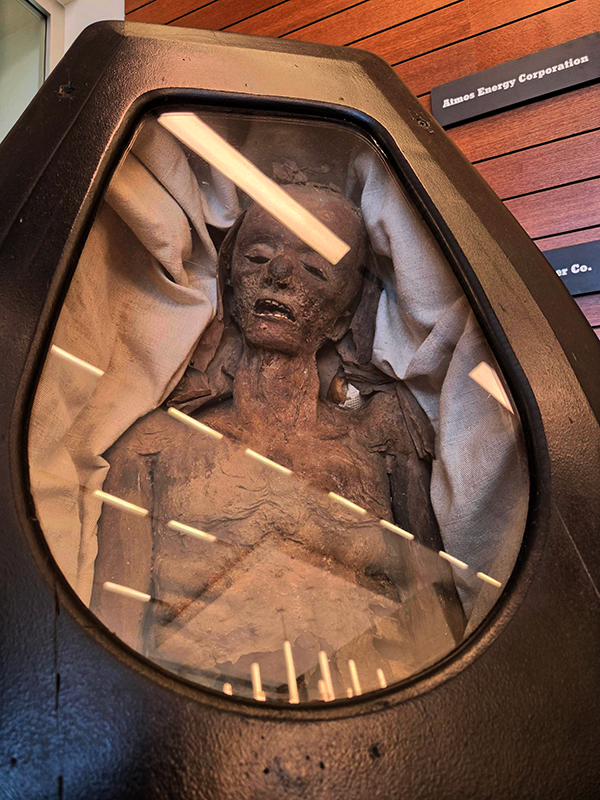
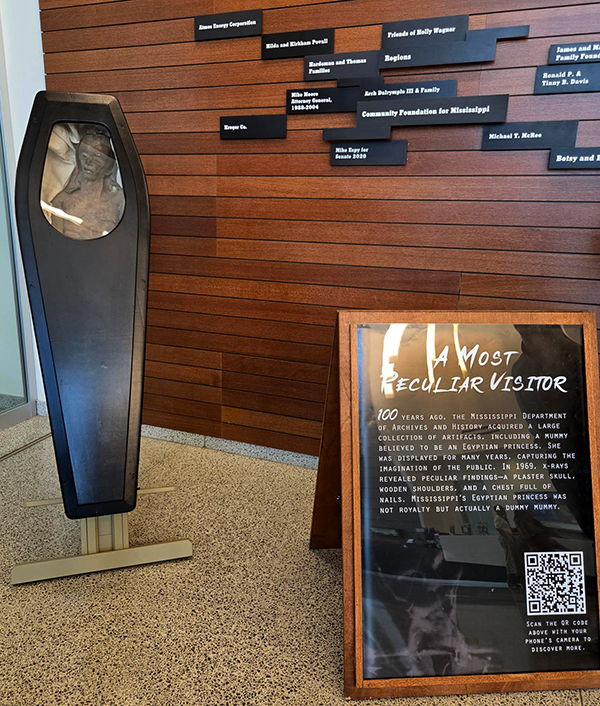
An infamous, undead legend is back on display for a limited time at the Two Mississippi Museums. The Dummy Mummy, enclosed in her cloth-lined, black wooden coffin, will haunt the halls of the Museums this Halloween season.
In 1923, MDAH acquired a collection of thousands of artifacts from James Sessions Butler. Included in those artifacts were Native American tools, pottery, and a mummy believed to be an Egyptian princess.
After being displayed at the Mississippi State Capitol through the 1950s, the Dummy Mummy was relegated to a storage room when the Old Capitol was restored and opened as the state history museum in 1961.
In 1969, medical student Gentry Yeatman was granted the opportunity to x-ray the mummy. Yeatman’s x-rays presented peculiar findings: Mississippi’s Egyptian princess was not royalty. In fact, she was made of papier-mâché, old newspapers, and as former MDAH Director Charlotte Capers reported, “a heart full of nails.”
All the same, Dummy Mummy has become a legend and local delight. The phony "Egyptian mummy princess" has thrilled generations of Mississippi children.
While the papier-mâché princess spends most of her time in storage, her time in the spotlight still spooks visitors of all ages. Her shriveled skin, shut eyes, and agape mouth seem on the verge of coming to life.
This year, the Dummy Mummy will be on display at the Two Mississippi Museums through the end of October, returning to her tomb in storage on November 1.
Step back in time and discover the people, places and events that shaped Mississippi during the Colonial era at Journey to Colonial Mississippi: An America250 Celebration on Saturday, October 3, at the Old Capitol Museum in Downtown Jackson.
The free event runs from 9 a.m. to 4 p.m. and will offer visitors an opportunity to experience colonial history through engaging demonstrations, educational presentations and hands-on activities. It is part of a three-day exploration of Mississippi’s historic past.
This one-of-a-kind program is part of a nationwide America250 commemoration celebrating the 250th anniversary of the founding of the United States.
Throughout the day, visitors can explore what life was like in colonial Mississippi and learn more about the diverse people and cultures that influenced the development of the lower Mississippi Valley.
Living history demonstrations by the Atlanta Historic Dance group will bring the period to life through historic dance and interpretation, offering a glimpse into the social customs and traditions of the colonial era.
The event also will feature educational presentations highlighting the life and legacy of Marquis de Lafayette, a French aristocrat and military officer who became an important figure in the American Revolution.
With educators dressed in period-specific wardrobes, the presentations and activities will help place Lafayette’s story within the broader history of the American Revolution and its connections to Mississippi. Visitors will feel like they are listening to Lafayette himself!
Families and history buffs can participate in hands-on activities designed to make the colonial period accessible and engaging for visitors of all ages.
Journey to Colonial Mississippi is an official America250 project made possible by a grant from the Mississippi Humanities Council, through support from the state of Mississippi.
Visitors are encouraged to bring family and friends for a full day of history, living history demonstrations, educational programs and activities celebrating Mississippi’s place in the story of America.
For more information, call (601) 576-6850 or email info@mdah.ms.gov.
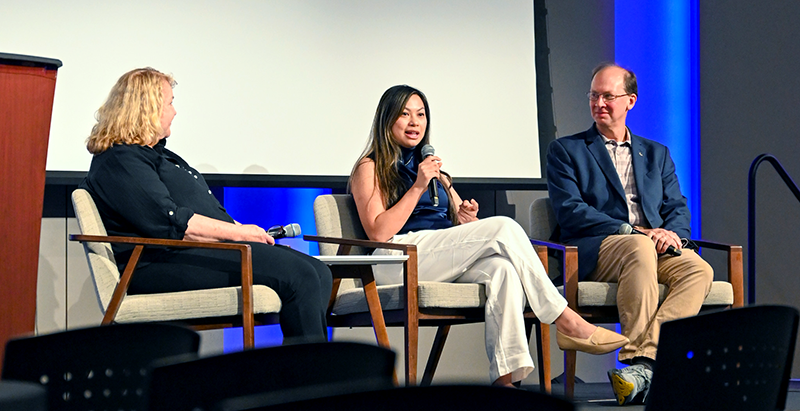
Panelist Emma To answers questions from the audience at History is Lunch: The Fisher People.
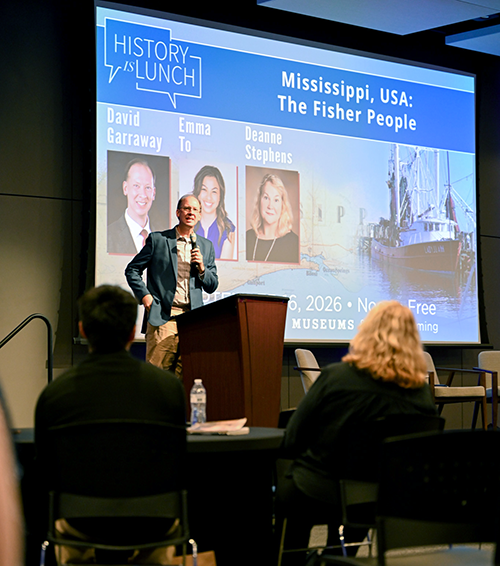
A large audience of history buffs attended a special screening of the second episode of The Fisher People, a four-part documentary series by Mississippi State University Television Director David Garraway. The screening was part of the History Is Lunch series at the Two Mississippi Museums and it comes ahead of the documentary’s premiere next month on Mississippi Public Broadcasting.
Panelists Emma To, certified registered nurse anesthetist and assistant professor at the University of Southern Mississippi; Deanne Stephens, co-director of the Center for the Study of the Gulf South and professor of history at the University of Southern Mississippi; and Garraway fielded audience questions at the conclusion of the screening.
As the Vietnam War entered its final days in 1975, many South Vietnamese citizens looked for a path to a better life. For some, that path ended in Mississippi.
“The commercial seafood industry made the Mississippi Gulf Coast,” said Stephens, who appeared in the film. “In the beginning of the seafood industry, you did have locals who worked in the industry. But there were not enough locals, and the labor demands, once you began the processing plants, were so great that there had to be a different labor source.”
Mississippi State University Television Director David Garraway welcomes the audience to the special screening of The Fisher People at Two Mississippi Museums.
The documentary explores the immigration experiences of Vietnamese refugees on the Mississippi Gulf Coast that have defined life along the shore for the past fifty years.
The film’s second episode gave a glimpse of a rocky start for refugee fisherman and how change didn’t come quickly.
“My dad would bring his boat by (locals’ boats), and then they would have their shotguns out on their shoulders,” said To, who also appeared in the film. “And it's almost like they didn't say anything, but it was almost like, know your place. It was almost like a silent threat, if that makes sense.”
To also reflected on the resilience and gratitude shared by many first-generation Vietnamese families.
“I feel like our parents kind of want to be unseen, not making a commotion. They just are grateful that they're in America, and they don't want to complain too much,” To said. “(Our parents) feel like this is already a blessing that we are here.”
Stephens noted that many Vietnamese refugees arrived in Mississippi seeking peace and stability.
“I am not surprised that it is not talked about,” Stephens said. “They came here with all good intentions. They meant no harm. They wanted to just have a quiet life for their families.”
“And that was not what greeted them at the beginning.”
Produced by MSU TV, The Fisher People offers an in-depth look at the history, culture, and lasting impact of Vietnamese communities on the Mississippi Gulf Coast. The four-part documentary series premieres on Mississippi Public Broadcasting on Oct. 2 at 8:30 p.m., with new episodes airing weekly through Oct. 23
MDAH’s History Is Lunch series is presented Wednesdays at noon in the Craig H. Neilsen Auditorium of the Two Mississippi Museums in Jackson and is free to the public. These programs explore Mississippi history and culture through presentations by scholars, authors, and experts from across the state and nation.
Mississippi Gulf Coast Community College President Mary S. Graham, Ph.D., has been elected to the Mississippi Department of Archives and History Board of Trustees.
Graham of Perkinston replaces outgoing board member Nancy Carpenter of Columbus. The nomination must be confirmed by the Mississippi Senate.
“Dr. Graham’s extensive leadership in higher education coupled with her deep understanding of Mississippi communities will be a huge benefit in our efforts to preserve historic places, expand access to our museums and support educational and preservation training efforts across the state,” said Spence Flatgard, president of the MDAH Board of Trustees.
Graham is the 12th president of the community college that has campuses and educational centers in south Mississippi and along the Gulf Coast. Graham, who began her career at the college in 1987, was named president in 2011.
During her tenure, MGCCC has been ranked as one of the Top 10 community colleges in the United States by the Aspen Institute and was selected as a national Bellwether Award finalist, reflecting the college’s leadership in innovation, workforce development, and student-centered excellence.
"Serving as president of an institution with a 115-year history has given me a deep appreciation for the importance of preserving the stories, people, and places that shape who we are,” Graham said. “I am honored to join the Mississippi Department of Archives and History and look forward to supporting its work to preserve Mississippi’s rich history while ensuring it remains meaningful and accessible for generations to come."
Graham’s leadership roles include serving as chair of the board of directors of the American Association of Community Colleges and as chair of the Mississippi Association of Community and Junior Colleges Presidents Association. Graham also serves on the Mississippi Power Association Board of Directors, Women in Higher Education Mississippi Network Board, the Phi Theta Kappa Board of Directors and is currently the chair for the Mississippi Humanities Council Board of Directors.
The MDAH board voted on Graham’s nomination during its Aug. 18 meeting.
In addition to Flatgard, the board members are Lucius M. Lampton of Magnolia, vice president; Cyrus Ben of Philadelphia; Reginald Buckley of Jackson; Carter Burns of Natchez; Betsey Hamilton of New Albany; Mark E. Keenum of Starkville; and TJ Taylor of Madison.
The Mississippi Department of Archives and History is the second-oldest state department of archives and history in the United States. The department collects, preserves, and provides access to the archival resources of the state, administers various museums and historic sites, and oversees statewide programs for historic preservation, state and local government records management, and publications.
A new performer will headline the upcoming History Happy Hour at the Two Mississippi Museums.
The Mississippi Department of Archives and History previously announced that comedian Rita Brent would perform at the event. Now, she is unable to attend. Brent is traveling abroad and is experiencing flight complications.
In her place, Grammy Award winner Dexter Allen will take the stage. A Jackson-based artist, Allen blends the soulful roots of blues with electrifying showmanship, captivating audiences worldwide with his powerful guitar riffs and unforgettable performances.
This free event will also feature two specialized flash tours of the Mississippi Made exhibition, focusing on sports and music, at 5:15 p.m. and 6:45 p.m. Mississippi Made is a special exhibit, sponsored by Wayne-Sanderson Farms, currently on display at the museums.
Two Mississippi Museums members, Blue Cross & Blue Shield of Mississippi employees, and Mississippi Museum Association Conference attendees will receive a complimentary drink. For more information, call 601-576-6850 or email info@mdah.ms.gov.
Subscribe to the MDAH Weekly Update and the Mississippi History Newsletter to keep up with all the latest news, upcoming programs, and special exhibitions at the Mississippi Department of Archives and History.